




For decades, media planning has revolved around three familiar currencies: impressions, reach, and frequency. These are clean, tradable, and operationally convenient. They map neatly to inventory, pricing, and guarantees.
And yet, they may also be quietly undermining campaign effectiveness.
When the objective is awareness, planners push for maximum reach, distributing impressions as broadly as possible. When conversion is the goal, frequency increases, reinforcing messaging among those already exposed. A balance is often struck using a ‘one-size-fits-all’ planning heuristics like the “effective frequency” rule of 3+ exposures within a channel.
But here’s the uncomfortable truth: reach and frequency only tell us how many saw and how often. They don’t tell us what actually worked. Even more critically, they treat each channel in isolation, ignoring how real people experience campaigns: as connected multi-touch journeys across platforms, formats, and environments.
That’s where inefficiency begins.
Because when we shift the lens from delivery metrics to incremental brand lift, a very different story emerges – one that challenges long-standing planning dogma and reveals hidden inefficiencies inside even the most well-optimized media plans.
What happens when you measure incrementality, not just delivery
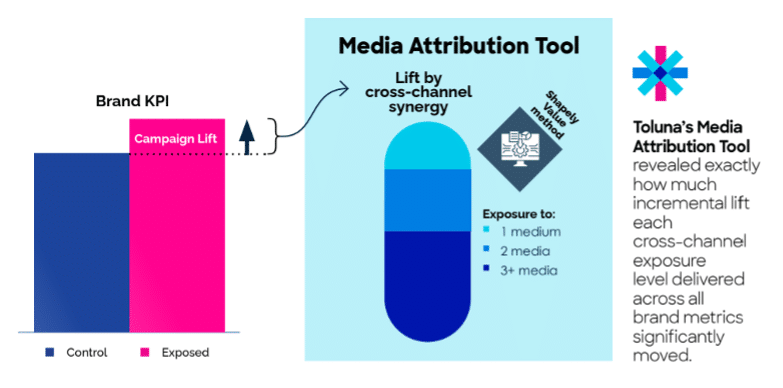
Across hundreds of cross-media effectiveness studies, we analyzed campaigns using a control–exposed design to establish true causal lift. We then applied Toluna’s proprietary Media Attribution tool to isolate and quantify the incremental contribution generated at different levels of media exposure.
The goal was to understand:

What happens when audiences see advertising through one channel only?
What happens when they see it through two channels?
What happens when they see it through three or more channels?
What the data told us
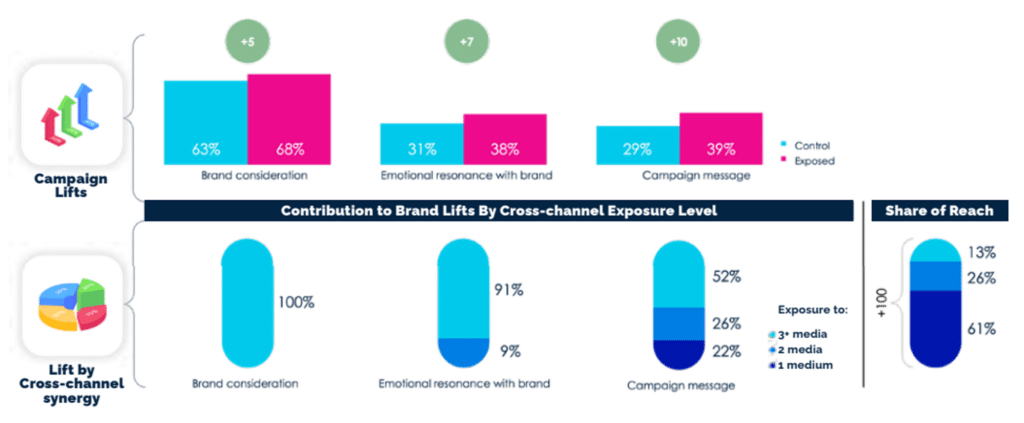
The charts accompanying this article reflect real campaign data and illustrate patterns we consistently observe across brands, categories, and objectives.
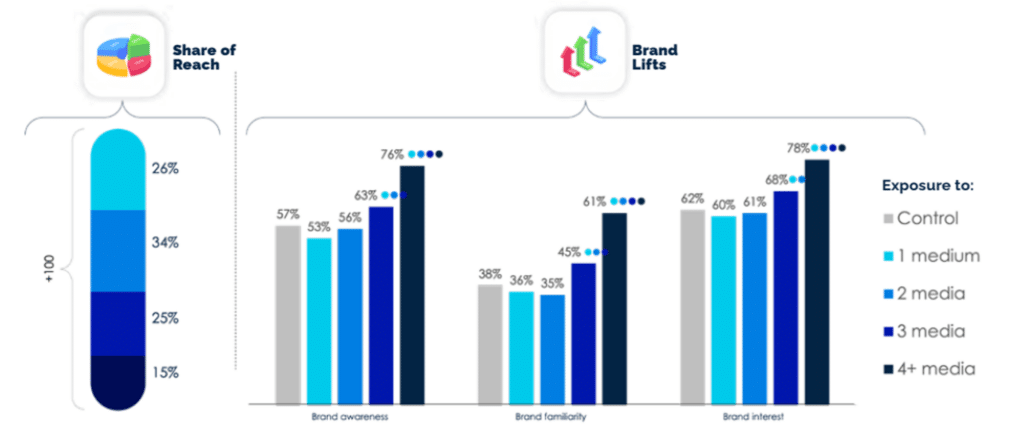
The top section below shows Brand Lifts delivered by the full campaign, representing the impact of the full media mix.
The bottom section deconstructs each Lift, isolating the contribution generated by single-channel exposure, two-channel exposure, and three-or-more-channel exposure, with the reach at each level shown for context.
The results are striking.
Three patterns that challenge traditional media planning

1. Campaign impact doesn’t grow linearly.
Incrementality tends to plateau when optimizing within single channels. More impressions in the same environment do not proportionally increase brand outcomes. Returns diminish.
2. The sharpest lift occurs at 3+ channels working together.
For upper- and mid-funnel KPIs – awareness, message association, brand perceptions, preference, etc. – the real acceleration happens when audiences are exposed to 3 or more media channels.
This is where reinforcement turns into resonance.
Projecting the brand narrative across multiple channels creates a cognitive and emotional echo that strengthens memory encoding, deepens persuasion, and amplifies impact.
3. A small share of the campaign’s reach drives most of the lift
In the representative example shown above, only 13% of total reach got to audiences that saw the advertising through 3+ channels.
Yet, that small portion of campaign reach accounted for:
- 100% of the lift in consideration
- 91% of the lift in emotional resonance
- 52% of the lift in campaign message association.
In other words, a relatively small portion of total reach generated the majority of brand impact. Meanwhile, the larger portion of campaign reach – those exposed through only one or two channels – contributed little meaningful incrementality.
The hidden inefficiency of “maximize reach”
When we examined sub-audiences based on number of channels exposed, the pattern remained consistent: meaningful lift emerged only when at least three channels worked together. Exposure through one or even two channels delivered limited incremental value.
Traditional planning dogma says: If the objective is brand building, boost reach.
So, budgets get stretched thin to broaden exposure. On paper, the campaign looks expansive. But in reality, many consumers experience the ad in just one or two environments. And those lower cross-channel exposure levels tend to be largely ineffective.
The result? A significant share of campaign impressions generates little real value.
This isn’t a media cost issue. It’s an allocation issue.
Channel frequency vs. synergy: a critical distinction
We also explored another core assumption: is increasing frequency within a single channel equivalent to cross-channel reinforcement?
The data says no.
When comparing:
Single-channel exposures delivered at high frequency
versus
Cross-channel exposures where each channel in the mix runs at low frequency
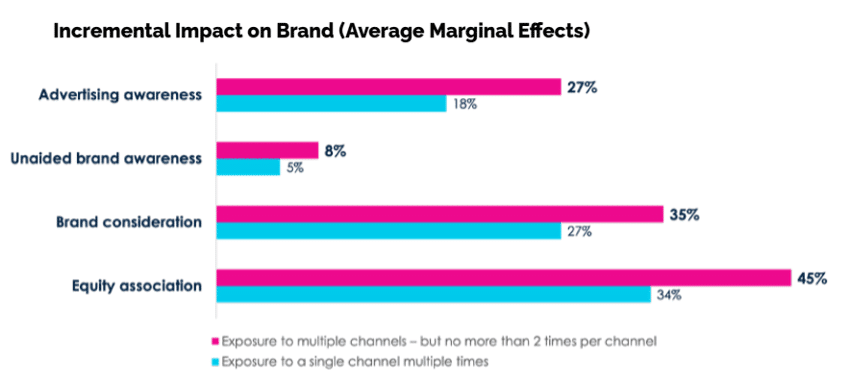
We found that reinforcing a message across channels amplifies impact more effectively than repeating it within one channel.
Advertising that reaches people from multiple directions deepens engagement, strengthens memory, and boosts impact, while minimizing ad fatigue. It creates reinforcement, not just repetition.
From volume to value: rethinking media effectiveness
Campaign budgets are never infinite. Every plan operates within a fixed pool of impressions.
So, the real question is not: How do we maximize reach? But rather: How do we deploy those impressions most effectively to maximize returns?
Our findings suggest that maximizing reach without enabling coordinated exposure can be suboptimal. Impressions that drive single-channel and two-channel exposures tend to underperform. The strongest gains come from multi-platform integrated exposure patterns that reinforce one another and create impact greater than the sum of their parts.
Yes, that may mean sacrificing some reach – the ineffective portion.
But the trade-off is clear: fewer wasted impressions, stronger incremental returns.
It’s time to evolve the planning currency
Media planning needs to shift:
From impressions to incrementality
From channel silos to cross-channel orchestration
From volume metrics to value creation
Because advertising isn’t experienced in silos. It shouldn’t be planned that way, either.
The future of media planning and execution isn’t about reaching more people. It’s about ensuring impressions work harder and create coordinated multi-touch exposure that augments impact.
That’s the real growth engine hiding inside today’s media plans.