






The advent of generative AI (GenAI) is disrupting market research in more ways than one. Our GenAI series taps into this evolution and unpacks what this means for our industry, what to expect moving forward, and how we at Toluna are innovating within the GenAI space. Check out part 1 and part 2 if you haven’t already.
In the third and final part of the series, we’re diving into GenAI native research: understanding what it means to extract insights directly from AI and uncovering how this shift is reshaping market research.
What is GenAI-native research?
GenAI-native research represents a shift from traditional market research as it involves deriving insights directly from GenAI engines – which means no survey, no project, no human panel is involved. Large GenAI LLMs like ChatGPT and Claude are trained on all kinds of data from social networks, forums, e-commerce sites and more, bypassing traditional research pipelines that require extensive human data collection and analysis.

A double-edged sword
By serving as a primary source of consumer insights, GenAI models are redefining what speed, scale, and competitive advantage look like in our industry. However, this evolution poses a significant potential risk to existing market research players, as it may result in reduced demand for traditional survey design, data collection, and analytical services – methodologies these market research players are centered on. Here’s how:

Insourcing through direct GenAI engagement
A growing number of technologically sophisticated companies will attempt to bypass traditional market research agencies altogether, leveraging powerful GenAI engines like OpenAI, Claude, and others to directly extract insights, identify emerging trends, and conduct preliminary research. This shift represents a fundamental challenge to market research firms as their clients gain the ability to perform basic analytical tasks internally and at a fraction of the cost. The ease of access and increasing sophistication of these AI models will democratize data analysis, empowering internal teams to derive actionable intelligence without external assistance.

Disruption by AI-native providers
AI-native firms – built from the ground up on a foundation of full AI pipelines – are emerging. These firms don’t just use AI as a tool; their entire operational framework is powered by advanced AI algorithms. Such players will offer a significant added value beyond a simple session with a GenAI engine, providing comprehensive solutions that are faster, more accurate, and more cost-effective than traditional methods.

Transformation of the traditional market research pipeline
Even for market research companies that choose to adapt, the traditional pipeline will undergo a profound transformation. Every stage of the research process – survey design, data collection, qualitative analysis, predictive modeling, report writing – will be optimized and enhanced by AI. This will result in higher quality insights delivered at a fraction of the current cost and time. Companies that fail to integrate GenAI effectively into their existing workflows will quickly find themselves uncompetitive, unable to match the efficiency and output of their AI-augmented rivals.
Given these formidable challenges, it’s clear that market research companies face a stark choice: adapt or be replaced. For those who choose to embrace AI-first approach, however, the opportunities are remarkable.
Beyond direct insight extraction, GenAI can also address brand monitoring and deep research needs. LLMs can rapidly process large amounts of unstructured data – social media conversations, online reviews, news articles, etc. – to provide real-time brand sentiment analysis, identify emerging trends, and uncover deeper consumer perceptions that may be overlooked by traditional methods. This enables more agile and comprehensive monitoring of brand health and competitive landscapes, offering another avenue for GenAI to redefine market research practices.
The integration of GenAI across various stages of the market research lifecycle, from initial concept testing to post-launch performance monitoring, is likely to reshape the industry significantly. The challenge, then, is to bring the speed and agility of AI into the market research framework and deliver insights, recommendations, and answers that are reliable and scalable to a global market.
Toluna’s AI solutions
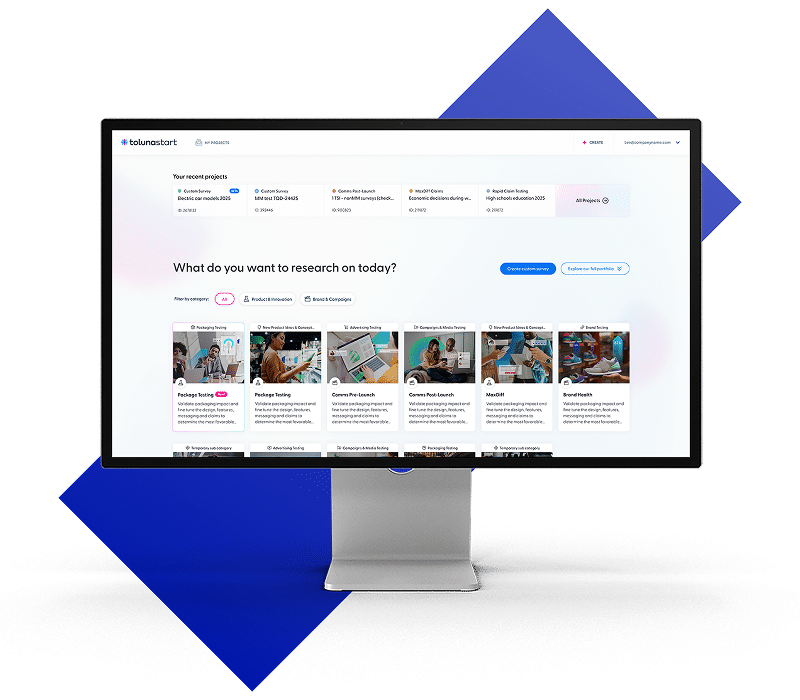
At Toluna, we started investing in full AI solutions to address new needs while still relying on proven methodologies and industry benchmarks. The first 2 products we released specialize in claim testing and ad effectiveness. In both cases, we deliver insights that are similar to those delivered by traditional products (i.e. using the same KPIs against the same benchmarks), but the actual generation is done directly with a complex agentic AI system that includes our virtual panel as a predictive engine at its core.
We guarantee 80% minimum correlation with real human answers. With a complete AI-based model, we’re able to conduct rapid testing in multiple iterations, allowing for the testing of various claims or videos without a huge human panel. These solutions are fully integrated into Toluna Start and will soon become fully automated for ease of use. Learn more here. Toluna is emphasizing the use of its virtual panel in all its AI native solutions.
The future of market research
The market research landscape is on the cusp of a radical transformation thanks to GenAI. While this shift threatens the existence of traditional market research players, it also creates new opportunities for those agile enough to embrace an AI-first approach.
The future of market research belongs to those who don’t see AI as a threat, but rather as a catalyst for innovation and competitive advantage. Toluna is pivoting to remain a market leader in this space by relying on these key assets:
Years of data: longitudinal data, customer data, market data – all of which is unique, proprietary, and leveraged to build and improve our AI models.

AI expertise, built on years of experience: The Toluna team started working on advanced AI models over 8 years ago.

Technical know-how and expertise in multiple domains and market verticals: We’re a proud team of experts who know our clients, their needs, and how to achieve them.

Our engaged client base who trusts us to make decisions.
AI promises democratized insights and unparalleled scalability. It also demands rigorous attention to data quality, bias, reproducibility, and ethical considerations. The future of market research will undoubtedly be hybrid, blending the strengths of AI with the irreplaceable facets of human expertise (critical thinking, strategic interpretation, and nuanced understanding). Ultimately, GenAI is not just a tool but a catalyst for a fundamental reimagining of how organizations understand and engage with their markets.
This was the third and final part of our GenAI series. Download the full report here.