





Proof of value wins: the shopper’s value mindset is here to stay
Wave 2 of Toluna’s Shopper & Retail Tracker shows a shopper who is spending more out of necessity and narrowing baskets. They’re formalizing value behavior while raising expectations for convenience, transparency, and responsible technology.
In case you haven’t read our blog post on Wave 1’s findings, read it here.
A shopper reset is underway
. . . and it’s changing the questions retailers need to answer.
Retail has always been shaped by trade-offs. What’s notable right now is how consistently those trade-offs show up across missions, cohorts, and retailer types. In wave 2, 61% of US households report their spending increased over the past three months, primarily due to inflation and rising prices. At the same time, consumer spend remains concentrated in mass and grocery, with grocery showing notable momentum this past quarter.
Wave 2 signals a shopper who has become highly adaptive, prioritizing essentials and building new routines around value.
The basket is narrowing
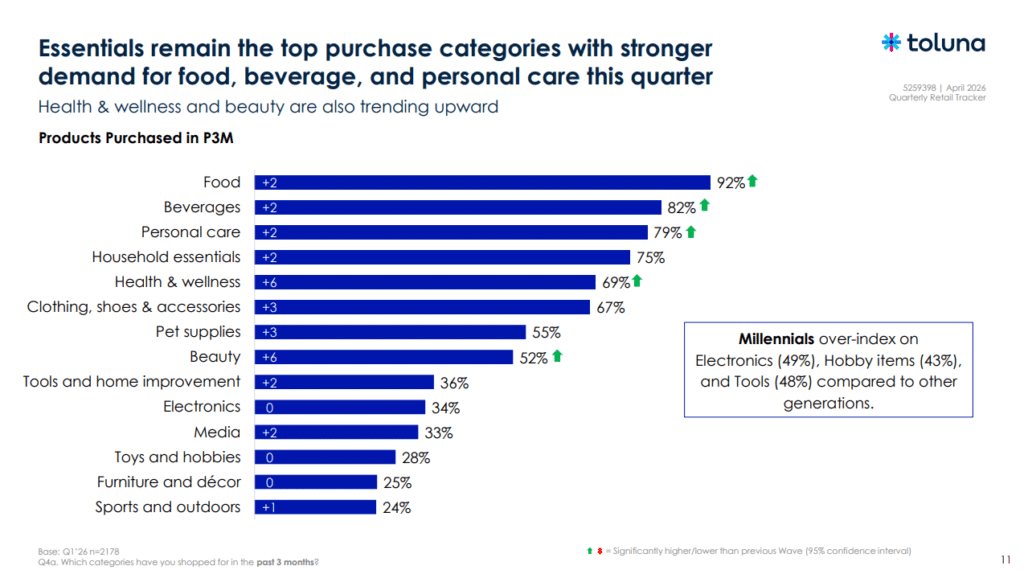
Essentials remain the center of gravity. In Wave 2, the most purchased categories in the past three months are food & beverages, personal care, and household essentials, while discretionary areas (e.g., media, toys/hobbies, furniture/décor) trail behind.
As shopping becomes more replenishment-driven, reliability matters more than ever. That aligns with what we see in store-choice drivers: low prices and convenient location lead, followed by wide selection and promotions/discounts.
Value-seeking has matured into a shopping doctrine
Wave 2 indicates that value behaviors are not fading; in fact, they’re becoming routine: 46% are comparing prices more often, and 38% are buying more store-brand products (among other shifts).
Looking across generations, Boomers are cutting back more drastically, delaying or completely avoiding non-essential purchases, switching to store brands, and reducing the frequency of their shopping trips.
Retail choice remains pragmatic
Low prices remain the primary driver of retailer choice, but convenience and assortment are growing in importance since wave 1 late last year. Retailers will increasingly need to meet shoppers where their needs differ. Boomers are most impacted by location and budget, while product selection and quality also matter. Store practices (integrity, sustainability, DEI) remain more impactful for Gen Z and Millennials.

AI is a trust paradox: high awareness, uneven comfort
AI literacy is relatively strong: 78% say they’re somewhat or very familiar with AI in the shopping experience. But trust is mixed: 23% trust AI a lot, 53% trust it a little, and 24% don’t trust it at all.
When testing specific AI-enabled features, receptivity and discomfort coexist. In Wave 2, about a third of shoppers rate several common AI concepts as helpful, yet many rate similar experiences as intrusive depending on the use case and perceived data boundaries.
This post highlights only part of wave 2 of Toluna’s quarterly retail tracker. The full wave 2 report includes deeper cuts by generation and retail format, retailer drivers and barriers, loyalty/NPS performance, AI sentiment boundaries, and social commerce behaviors.
Request the full report below or book a meeting with one of our experts to discuss what these findings mean for your business and how we can support your broader consumer and shopper research needs.
Questions? Contact Christine Ciullo: christine.ciullo@toluna.com
The latest wave of the shopper and retail tracker was conducted via Toluna Start and fielded between February 25th and March 4th, 2026, amongst a nationally representative sample of 2,000 U.S. primary shoppers, adults 18+.
In the full report, gain access to even deeper insights and updates to findings from wave 1, including: