





Why brands need contextual messaging optimization for humans and AI
At OMR this year, one theme consistently resurfaced across conversations on AI, search and digital visibility: brands are entering an era where they must become mentally available not only for consumers, but also for AI.
This is a fundamental shift.
For decades, marketers optimized communication primarily for human interpretation. Even SEO, despite its technical foundations, ultimately focused on improving discoverability for people searching online.
Generative AI changes this dynamic entirely.
AI systems no longer simply rank links. They interpret context, synthesize information, compare alternatives, and generate recommendations. Increasingly, consumers will not navigate directly to brand websites to evaluate options themselves. Instead, they will rely on AI-generated answers, summaries and suggestions.
This creates what I believe is a new strategic requirement for brands: contextual messaging optimization for humans and AI.
Because AI does not interpret brand communication the same way consumers do.
Large language models search for semantic clarity, consistency, contextual relevance and structured signals across digital ecosystems. They pull information from websites, product pages, reviews, articles, FAQs and third-party sources to construct recommendations independently.
Which means that messaging can no longer be optimized only for persuasion. It also needs to be optimized for interpretation. Brands are no longer competing only for consumer attention. They are increasingly competing for recommendation.
From Claims Testing to Contextual Messaging Optimization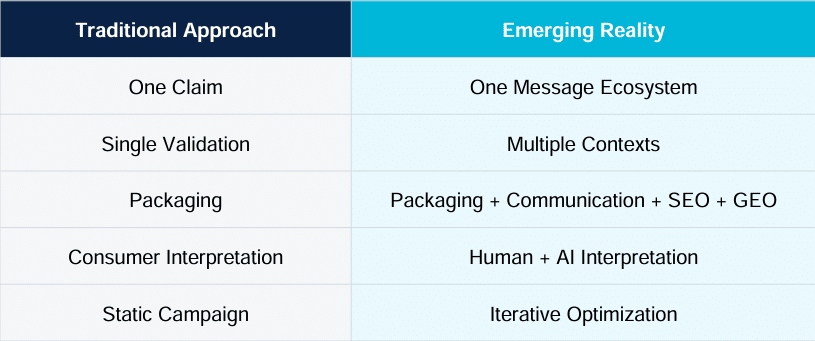
A claim that performs strongly in a traditional consumer test may not necessarily be the claim most likely to surface in AI-generated recommendations. Similarly, a message designed for packaging may not be the message best suited for GEO environments or conversational search contexts.
The implications for marketers are significant.
Many organizations still evaluate claims in relatively static environments: a packaging test, a communication test, or a campaign pre-test. But AI-driven discovery introduces entirely new contextual layers. The question is no longer simply: „Does this message resonate?“ The better question becomes: „In which context does this message need to perform, and for whom?“
Marketing is moving from a world of attention toward a world of interpretation and recommendation.
At Toluna, we believe these shifts create an important opportunity to rethink how messaging development may evolve in increasingly AI-mediated environments. The industry may need more iterative and context-aware approaches to understanding how messaging choices influence consumer interpretation across different discovery and decision-making contexts.
Imagine a product launch process where brands do not test only one final claim set, but systematically optimize messaging for:
- front-of-pack communication
- back-of-pack explanation
- campaign messaging
- social amplification
- GEO discoverability
- AI recommendation environments
- contextual search visibility
Not as isolated exercises, but as part of one integrated messaging ecosystem.
This matters because the future competitive advantage may not belong to the brands with the highest volume of content. It may belong to the brands whose messages are most interpretable, contextually relevant and recommendation-ready across both human and AI systems.
For years, digital marketing rewarded reach and attention. But in AI-driven environments, credibility becomes infrastructure. AI systems increasingly prioritize signals that appear trustworthy, specific, structured and contextually validated.
This changes how brands need to think about communication architecture altogether. Messaging becomes less about isolated slogans and more about building coherent semantic ecosystems that AI can confidently interpret and recommend.
The organizations that start building these capabilities early will likely gain a significant advantage as AI-driven search and recommendation behavior accelerates.
This opens a new strategic space for insight-led organizations: moving from static claims validation toward dynamic contextual messaging optimization. And this may ultimately become one of the most important evolutions in modern brand communication.
Interested in discussing how AI-driven discovery may reshape the future of brand communication, and how brands are using Rapid Claims AI and synthetic personas to better understand consumer reactions to messaging approaches? Let’s connect.
Claudia Gelbe, Managing Director DACH @ Toluna
claudia.gelbe@toluna.com