






Few topics in brand strategy generate as much debate as difference.
That debate resurfaced at Cannes Lions 2026, when Mark Ritson and Byron Sharp shared the stage to explore where modern marketing thinking agrees, and where it still doesn’t. While they found common ground on several important principles, the role of differentiation remains part of a much wider debate within marketing.
The more useful question may not be whether difference drives brand growth. It’s what kind of growth difference helps create.
Toluna’s research suggests that difference plays a distinct commercial role, one that becomes clearer when we look beyond penetration and consider pricing power.
Difference and distinctiveness are not the same thing
First, it’s worth clearing up a common source of confusion. Difference and distinctiveness are sometimes used interchangeably, but they describe quite different things.
Difference is about what sets a brand apart from its competitors in consumers’ minds. It might come from a product, service, experience, positioning, innovation, or some combination of these.
Distinctiveness is about being recognizable and unmistakably yourself. Distinctive Brand Assets such as colors, characters, packaging, logos or sonic cues help consumers recognize a brand and correctly attribute communications to it.

As Byron Sharp neatly describes the objective, it is about creating “a brand that looks like itself.”
Distinctiveness therefore plays an important role in supporting Mental Availability. The easier a brand is to recognize, the easier it is to build and reinforce the memory structures that help it come to mind in buying situations.
Difference is set to do a different job. And that distinction becomes particularly interesting when we look at real commercial outcomes.
Difference doesn’t necessarily make brands bigger
Toluna conducted a large-scale validation of different dimensions of brand equity across snacking food brands in 16 European markets. We compared consumer perceptions with commercial outcomes including brand size, penetration, and price.
The results told an interesting story. Mental Availability and Emotional Resonance both demonstrated strong relationships with brand size and penetration. Difference did not. In fact, across the analysis, the average correlation between difference and penetration was just 0.01, effectively no relationship at all.
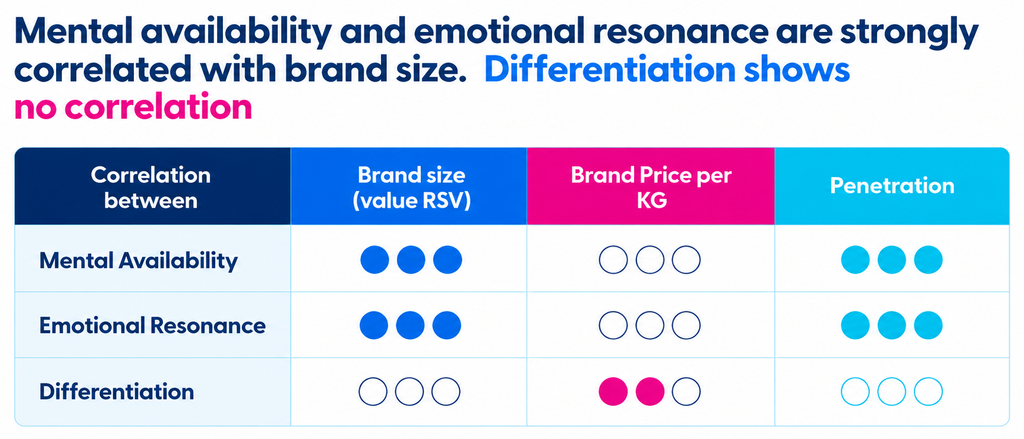
The table illustrates the EU summary across the 16 markets, of the correlation between the different variables
- 3 colored circles = strong correlation
- 2 colored circles = average-good correlation
- 0 colored circles = no correlation
This confirms that brands do not necessarily become big because consumers perceive them as fundamentally different from everything else in their category. Other dimensions of equity, particularly being widely thought of and building strong connections with consumers, appear much more closely related to attracting more buyers.
But that’s only half the story…
Difference may help brands become worth more
When we looked at the same data through a different commercial lens, the pattern changed considerably. Rather than comparing difference with penetration or brand size, we looked at its relationship with pricing. Here, the relationship was much stronger.
Across the 16 markets, difference had an average correlation of 0.56 with actual price, with an even stronger relationship with consumers’ perceptions of price.

This suggests a different way of thinking about the role of difference. Difference may not be strongly associated with how many people buy a brand, but it appears much more strongly associated with the value consumers attach to it.
Of course, correlation isn’t causation. This analysis doesn’t tell us that simply making a brand appear more different will automatically allow it to increase its prices. But it does suggest that judging difference purely by its relationship with penetration risks missing an important part of its commercial role.
James Hurman has made a related point in revisiting the economic origins of differentiation: the concept was originally associated with reducing direct price competition and giving businesses greater control over pricing, rather than simply explaining which brands consumers choose. Seen through that lens, we may have been judging difference against the wrong commercial outcome.
Instead of asking whether difference makes brands bigger, we should be asking whether it helps make them more valuable.
CASE STUDY: DIFFERENCE IN ACTION
Toluna’s work in the pet care category provides a useful illustration of how difference can support perceived value and premium positioning. Newer entrants into the category often use clearly differentiated propositions to give consumers a reason to see additional value in their offer, whether through product quality, natural ingredients, specialist expertise or a new approach to pet health and wellbeing.
In European markets, where pets are increasingly treated as members of the family, the opportunity goes beyond functional product benefits. Brands with a clear and differentiated proposition can provide emotional reassurance as well as practical benefits, strengthening consumers’ sense that they are making the right choice for their pet and helping support a premium price. We see a similar dynamic in Asian markets, where highly specialized propositions are addressing specific pet health and wellbeing needs. Even against a backdrop of pressure on household budgets, a focused point of difference can help brands demonstrate why they are worth paying more for, combining tangible benefits with the reassurance that pet owners are doing the best they can for their pets.
The lesson is not that difference alone creates a successful premium brand. Rather, when difference is relevant, clearly understood and connected to something consumers value, it can give people a compelling reason to pay more.

Different dimensions of equity do different jobs
This brings us back to the wider debate. The challenge is that we often look for a single explanation of brand growth, when different dimensions of brand equity appear to contribute to different commercial outcomes.

Mental Availability matters because brands need to come to mind across the buying situations that drive category demand. In our previous analysis across more than 4,300 brand observations, Mental Availability demonstrated a substantially stronger relationship with penetration than spontaneous awareness.

Emotional Resonance relevance matters because brands need to build strong connections with consumers, and in our 16-market analysis it also showed a strong relationship with brand size and penetration.

Distinctiveness helps brands become recognizable, strengthening the chances that communications and experiences are correctly attributed to them.

And difference appears to play another role: helping brands stand apart in ways that support perceived value and pricing power.
Seen this way, the debate becomes less binary. It isn’t about choosing between difference and distinctiveness, or deciding that one school of marketing thought is right and another is wrong. It is about understanding which dimensions of brand equity relate to which commercial outcomes, and managing them accordingly.
Implications for brands
1. Are we trying to become bigger, more valuable, or both?
Growth isn’t a single outcome. If increasing penetration is the priority, our evidence suggests Mental Availability and Emotional Resonance deserve particular attention. If maintaining or strengthening a price premium is strategically important, difference may have a greater role to play.
2. Are we measuring difference and distinctiveness separately?
Being perceived as different from competitors isn’t the same as being instantly recognizable.
Treating the two as interchangeable risks obscuring what each contributes. Brands should understand both how clearly they stand apart and how easily consumers recognize them.
3. Do we understand what actually makes us different?
A difference score can tell marketers whether consumers see the brand as different. The more useful question is why. Understanding the products, experiences, benefits and associations behind that perception turns difference from another brand tracking KPI into something marketers can actually manage.

Ultimately the question isn’t whether brands need to be different, but what that difference can help them achieve.
Our evidence suggests that different dimensions of brand equity contribute to different commercial outcomes. Understanding those relationships helps marketers make smarter decisions about where to invest, what to strengthen and how to drive growth.
Because effective brand measurement shouldn’t just tell you where your brand stands. It should help you understand what to do next.
Understand what drives your brand’s growth.
Discover how Toluna helps brands connect consumer perceptions with commercial performance, turning brand insights into smarter decisions.