


Five years ago, Toluna and SAN (the Netherlands Advertiser Jury Foundation) set out to answer a simple question: do the campaigns recognized by one of the country’s most respected advertising effectiveness juries score as highly when evaluated through Toluna’s AI-powered advertising effectiveness solutions? The answer was yes.
Completing the SAN-Toluna trilogy
This study represents the third chapter in an ongoing collaboration between SAN and Toluna as SAN’s Insights Partner. In our first article, we explored how algorithms, in combination with human coding, can help marketers evaluate creative effectiveness at speed. In the second article, we analyzed SAN-winning campaigns to uncover the storytelling characteristics that set the strongest creative work apart. Now, we’re revisiting a question first explored five years ago: can a new generation of AI tools reach the same conclusions as an independent panel of experienced advertisers and marketing leaders?
From algorithms to synthetic consumers
For this analysis, nearly 50 SAN cases from the 2022–2024 period were evaluated. This includes non-nominated entries, nominated campaigns, and SAN Accent winners, which were a mix of TV ads and online videos. Each campaign was assessed on two key dimensions: its ability to break through clutter and capture attention, and its potential to drive brand impact. What makes this study particularly significant is the technological shift that took place between the original research and today.
The earlier Creative Pre-Test Instant (then known as ACT Instant) approach relied on validated algorithms, norms, and expert coding to predict advertising performance. Creative Pre-Test Instant is based on a new approach powered by Toluna Synthetic Personas: AI-powered representations of consumers built on large-scale behavioral and attitudinal data.

“Our Synthetic Personas are designed to see, interpret, and respond to advertising in ways that closely mirror human respondents. They are not simply scoring models trained to recognize good ads.“
– Andy Santegoeds

The goal of the research was therefore not only to evaluate advertising, but also to explore whether our Synthetic Personas would arrive at similar conclusions to those of a respected human jury.
The findings
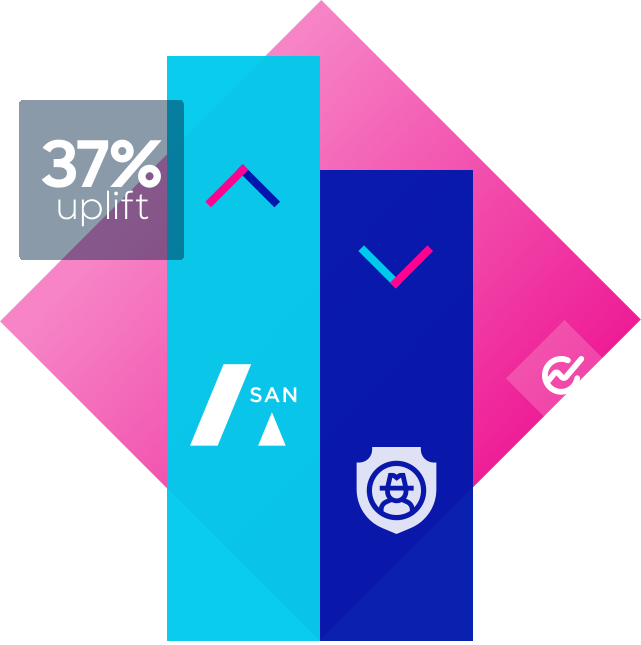
The answer was clear: winning campaigns consistently outperformed other entries on the core drivers of effectiveness. Compared with regular submissions, SAN winners generated significantly stronger predictions for both brand recall and message recall. In fact, winners showed an uplift of 37% on brand recall and 15% on message recall compared with non-winning campaigns.
The strongest campaigns were those that combined creativity with clear branding and effective communication. They left a stronger memory trace, created clearer connections to the brand, and delivered a more distinctive message.
The paradox of likeable advertising
Being liked is not necessarily the same as being effective. While winning campaigns consistently outperformed other entries on key effectiveness metrics such as brand recall and message recall, some non-winning campaigns scored just as well – some even scored slightly better – on overall likeability. In other words, consumers often found these campaigns entertaining, enjoyable, or emotionally appealing. As Kirsten van Wingerden, Group Commercial Director at Toluna, explains: “One striking finding is that ‘likeable’ is not synonymous with ‘winning’. Non-winning campaigns often score slightly higher on general likeability, but both the jury and the AI personas look beyond pure entertainment. Winning campaigns distinguish themselves through a stronger connection to the brand and clearer message communication. They are more likely to contribute to long-term brand building.”
The strongest campaigns created a clearer association with the brand and left audiences with a stronger memory of the message. This reinforces a lesson that many marketers intuitively understand but sometimes overlook. Joost Vossen, SAN board member and Vice President Brand & Go-to-Market at Elsevier, recalls a jury member’s remark: “It’s not about how much people like you. It’s about what you leave behind.”
Creative quality leaves signals
Five years after the original SAN analysis, marketers and consumer insights professionals take away the same conclusion – only now with new technology. A new generation of AI, embedded in Toluna’s Creative Pre-Test Instant, reaches the same conclusions as an independent panel of experienced advertisers and marketing leaders. And increasingly, both humans and AI agree on why.
Footnote:
The results of this study were initially published in leading Dutch trade magazine Adformatie’s Spring 2026 edition. Access is available (with a subscription) on Adformatie’s blog.
Toluna is an official Insights Partner of SAN.

Author: Andy Santegoeds
Senior Solution Consultant at Toluna
Andy Santegoeds has been a member of the board of SWOCC – the Dutch Foundation for Scientific Research into Commercial Communication – since 2013 and is a regular contributor of thought pieces about advertising and brands.

Author: Niels Bovee
Lead Insight Director – Creative Intelligence at Toluna
Niels has a unique role, overseeing Insight that is delivered from Toluna’s Creative Excellence solutions. He blends instinct, academic and AI forward creative insight into stories that fuel big picure learning for clients so they consistently improve their creative quality.