





As the world continues to grapple with climate change, sustainability has become increasingly important for consumers, brands, and governments alike. The shift towards renewable energy, eco-friendly practices, and green economies is picking up. The commercial opportunity within this space is estimated at a contribution of $10.3T to the global economy by 2050, which is equivalent to 5.2% of the global GDP that year. [1]
What remains a challenge for many brands, however, is effectively communicating about their sustainability initiatives and maintaining the renewed confidence to communicate about sustainability.
In our whitepaper, It is not easy being green, we explored the complexities brands face when it comes to their sustainability communications. Building on the insights shared, Toluna (formerly MetrixLab) conducted a global meta-analysis to uncover best practices for developing sustainability communications within the advertising space.
Leveraging our ACT Instant solution, we tested sustainability-led ads from various brands around the world across 130 creative elements. ACT Instant combines AI and human advertising expertise to provide results through a narrative lens, offering actionable insights and clear, practical recommendations for optimization.
Our findings encompass best practices across various pillars, including branding, messaging, and creative elements.
“Finding the sweet spot between creativity, commitment, and authenticity is key to achieving impact.”
Landing the message with impact
Your ad’s ultimate purpose is to drive mental availability of your brand and its distinctive assets. It should come as no surprise then that your brand should be at the heart of your ad even when you’re focused on communicating a specific cause or purpose. Don’t be afraid to flaunt it! Introduce your brand early in the creative and make it central to the cause or core message of your ad.
Our findings revealed that 67% of all successful ads on breakthrough (breaking through the clutter) feature the brand within the first 3 seconds,
and 64% had their brand present for at least 50% of the ad’s duration.
On the same note, your logo should be visible and prominently displayed – especially at the end frame of the creative. After all, your logo is often your most distinctive brand asset. 94% of tested creatives with a successful breakthrough feature their logo in the end frame. Where you place your logo is also important. Keeping it at the center of the creative frame works best.

How to land the message
Getting your message across in this complex space is pivotal to your ad’s success. We’ve rounded up key insights and best practices with regards to messaging:
1. Balance a rational message with emotive elements:
When communicating about sustainability, it’s important to balance the rational message with emotive elements. 2/3 of our tested successful creatives tend to lean more towards rational messaging, while 1/3 combine rational and emotional messaging to get their point across. Interestingly, this opposes more “traditional” TV ads, which tend to perform better when they strike a balance between emotional and rational messaging.
2. Tone down the humor – but balance seriousness with positivity:
Be wary of the use of humor in sustainability ads. Sustainability is not a joke, and only 9% of successful sustainability ads make use of humor. That said, balancing out the seriousness is important. We’re all aware of the looming dangers of unsustainable practices; people don’t necessarily want to be reminded of it. Which is why showcasing gloomy, disheartening visuals in your ad reduces the chances of success by 36%.
3. Show off your brand:
We’ve already touched on the importance of branding, but this point can’t be emphasized enough. Your brand is your ad’s hero – treat it as such!
Leverage creativity through human connection
Creativity is key to standing out from the crowd and leaving a memorable impression. Here’s what we’ve found works best when it comes to sustainability advertising:
4. Let humans tell the story:
Using humans to tell your story is a proven way to establish relatability and credibility. It also adds a human touch and fosters a sense of empathy among viewers. Our study revealed that a clear presence of humans has a positive impact on the success of sustainability ads: 72% of the ads with successful breakthrough features humans, as did 100% of ads with successful response rates.
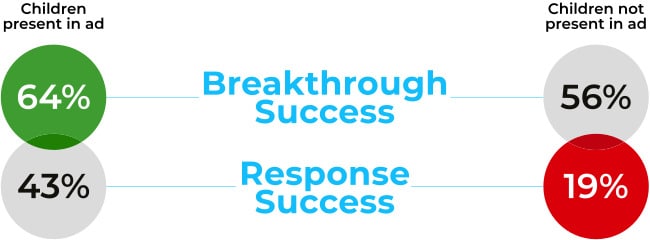
Earlier, we discussed the importance of keeping your brand front and center in your ad. Combine this with a human protagonist – positioning both at the core of the ad – and you’re setting yourself up for a 56% increase in success rate. Including children has proved to be particularly effective:
Celebrity presence can also drive breakthrough. However, it does not guarantee a strong response: we found that celebrity presence boosts breakthrough by 3 times more than response. It’s important to ensure you’re using the right celebrity for your ad – one whose image fits within your creative narrative, as well as your brand image. Authenticity and relevance are of the essence here.
Message early with synchronicity and positivity
Positivity and synchronization of messaging and visuals are critical:
5. Introduce the message early on and harmonize the verbal and visual components:
91% of successful creatives introduce their message within the first half of the creative duration. 100% of successful creatives deliver their message both visually and verbally, which demonstrates the importance of harmonization. Make sure to establish cohesion across video and audio – ads that do so are more likely to be successful. This rings true not only for sustainability-focused ads but general TV advertising.
Using supers is a great way to support your ad’s message visually – in fact, 81% of successful creatives leverage supers to communicate their message.
6. Support positivity with upbeat music and imagery:
As previously mentioned, positivity works when it comes to sustainability ads. Including upbeat music increases chances of success by 1.6 times. Even so, keep in mind that the primary focus of your ad is to tell a clear message. Make sure not to rely solely on positive framing to ensure success
“Showcasing forests, open fields, or flowing water does not necessarily guarantee success of sustainability-led creatives… A clear message and purpose do.”
Messaging elements for effectiveness
Communicating the message of your sustainability ad is easier said than done. There are various elements to get right. Here are the key insights we’ve obtained with regards to messaging elements that work best with sustainability ads:
7. Focus on the solution:
…not the problem. This is where positive framing can make an impact. What’s even stronger is making consumers feel part of the solution by telling a story that prompts action – more on that later!
8. Flaunt your storytelling skills:
The best sustainability ads tell a clear story without relying on too many vignettes. Interestingly, this applies not only to sustainability-related advertising but to our general TV advertising learnings. Learn more about TV advertising best practices here.
9. Involve consumers in your sustainability initiatives:
This way, not only do your efforts become more tangible and credible, but you create space for consumers to engage with your brand and take meaningful action. According to our analysis, sustainability creatives involving consumers in their initiatives are more successful than those which are solely centered on the brand’s efforts.
10. Apply single-minded messaging:
We’ve touched on the importance of delivering a clear message in your ad. To do this effectively, focus on a specific element or initiative of sustainability. It’s a vast area, so it’s important to be transparent about the specific steps you’re taking – be it clean energy, recycling, or something else. Ads mentioning a specific type of sustainability are 1.6 times more likely to be successful than ads that address sustainability as a general term. Be consistent to reinforce the messaging and association with the brand.
11. Remember that credibility is key:
In an age where greenwashing is rampant, backing your claims is crucial. 55% of successful tested creatives are supported by claims, and 36% have numerical claims. Steer clear of vague or misleading claims! Ensure that your brand has “permission” (from consumers) to own and associate itself with the cause or purpose – supported by your company’s visible and transparent commitment to sustainability.
12. Create a clear link between your brand and cause:
Ensure your brand’s association with the given cause has “permission” from the consumer for that association. Be consistent and reinforce the linkage through multiple media channels and an ongoing commitment in communications.
To summarize:
Focus on the clear rational messaging seamlessly combined with emotive elements
Tone down humour but balance the seriousness with positivity
Despite communicating a different “cause” or “purpose”, don’t be afraid to flaunt your brand
Let humans tell the story, they can drive the change. Children can help build the sustainability story
Introduce a harmonized message early, both visually & verbally, using supers if relevant
Support positive change with more upbeat music and imagery
Focus on the solution NOT the problem, bring positivity. Even better if consumers feel part of it
Best sustainability ads tell a clear story, they don’t rely on lots of vignettes
Involve your consumers in the journey towards sustainability. Make them feel they can make a difference
Single minded messaging: Focus on a specific “element” of sustainability: be consistent to reinforce the connection
Support your ad with authentic, substantiated claims
Create clear linkage between your brand and the “cause” – with consumer permission
References
- *Arup and Oxford Economics, 2023