





The marketing industry has made remarkable progress over the past 15 years in understanding how brands grow. Few concepts have had a greater influence than ‘mental availability’, popularized through the work of the Ehrenberg-Bass Institute and Byron Sharp in How Brands Grow. Most marketers now accept that brands grow by becoming easier to notice and remember across a broad range of buying situations.
Yet, despite broad acceptance of the theory, many organizations continue to measure mental availability using metrics that capture only part of what it is designed to explain.

One of the clearest examples can be found in brand tracking. While mental availability has become a cornerstone of modern marketing thinking, many tracking studies still rely heavily on spontaneous brand awareness (i.e. « When you think of category X, which brands come to mind? ») as their primary measure of saliency. The problem with this approach is that awareness and mental availability are not the same thing.
Mental availability is concerned with something broader: the likelihood of a brand being noticed and thought of across the needs, occasions, and motivations that trigger category demand. This is why Ehrenberg-Bass advocates measuring saliency through Category Entry Points (CEPs): the buying situations in which brands compete. Understanding a brand’s association with CEPs provides a richer picture of saliency because it captures the breadth and strength of the memory structures that influence choice.
Why awareness isn’t enough
Consumers may be able to recall a brand when asked a broad category question, but that doesn’t necessarily mean the brand will come to mind when they’re looking to treat themselves, celebrate with friends, solve a problem, or satisfy a specific need. These are the moments where brand choice is actually made.
This thinking has been central to Toluna’s brand tracking approach. More recently, we revisited the validation of our framework using over 4,300 brand observations from Toluna’s global database, which span a wide range of categories including soft drinks, alcohol, food, fashion, home improvement, pet care, and travel.
The findings reinforce the value of mental availability as a superior growth metric. Across the dataset, mental availability demonstrated a substantially stronger relationship with brand penetration than spontaneous brand awareness. in fact, mental availability explained 33% more variation in brand penetration than spontaneous awareness (R² = 0.73 versus 0.55).
Perhaps more importantly, brands with similar awareness levels often achieved very different penetration outcomes, whereas mental availability maintained a much tighter relationship with purchasing behavior. For organizations pursuing penetration-led growth, understanding and building mental availability is likely to be more valuable than focusing on awareness scores alone.
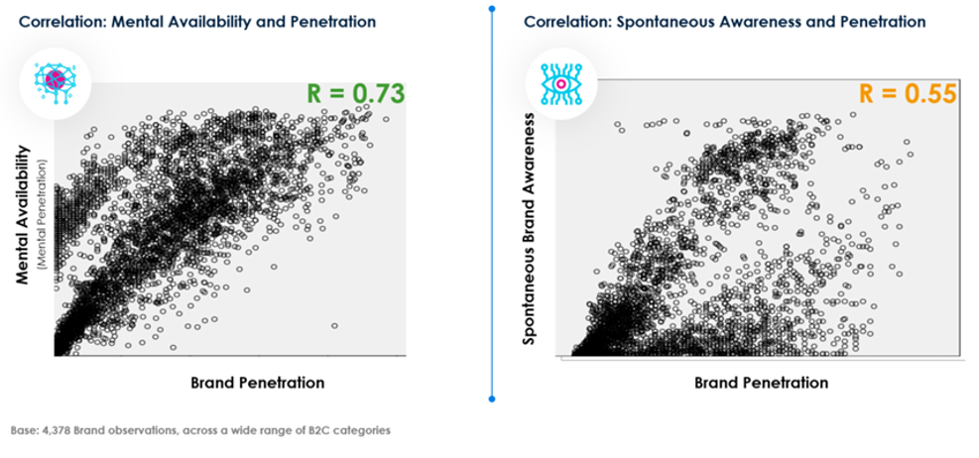
Across 4,300+ brand observations, mental availability explained 33% more variation in brand penetration than spontaneous brand awareness.
From measurement to growth
Perhaps the greatest advantage of mental availability is not that it is a better metric, but that it is a better growth framework. When a brand underperforms on awareness, the recommendations are often predictable: increase marketing investment, improve visibility, strengthen distribution or enhance in-store presence.
While these actions may be valid, they rarely answer a critical question: Where should the brand focus its efforts to generate the greatest growth? Mental availability helps answer that question. By identifying which CEPs are strongly linked to a brand, and which remain underdeveloped, marketers gain a clearer view of where opportunities exist to build saliency and future demand.
Milka‘s experience in Germany provides a useful example. In 2021, Milka was already the leading chocolate brand in the market, with awareness levels comparable to its nearest competitor. Traditional awareness measures suggested there was little room for improvement.
However, a mental availability analysis revealed a different opportunity. While Milka already possessed the broadest network of associations in the category, the analysis identified several strategically important CEPs where the brand had scope to strengthen its presence. These insights helped shape strategic priorities and informed communication planning over subsequent years.
Campaigns such as A Little More Tender and Grow the Tree were developed during this period. These initiatives helped reinforce Milka’s association with a broader set of consumption occasions and buying situations.
Renovation relaunch

Between 2021 and 2024, Milka strengthened its association with each of these priority CEPs. Over the same period, the brand increased its volume market share, further consolidating its leadership position in the category.
While many factors contribute to brand growth, Milka’s example illustrates the practical value of mental availability. Rather than simply reporting performance, it helps brands identify specific opportunities to build saliency and provides a framework for translating those opportunities into strategy and execution.
Implications for brands
The good news is that the marketing industry has largely accepted that mental availability matters. The challenge now is to ensure that brands are measured and managed in a way that reflects that understanding.
Spontaneous awareness remains a useful metric, but it provides only a partial view of saliency. Mental availability offers a more complete picture of how brands exist in memory, demonstrates a stronger relationship with penetration, and provides clearer guidance on where growth opportunities lie.
Brand teams should therefore be asking three simple questions:

Which CEPs drive demand in our category?
Which CEPs are most strongly linked to our brand?
Which represent our greatest opportunities for future growth?
Understanding the value of mental availability is only the first step. To drive real growth, organizations must ensure their brand tracking programs aren’t just providing a scorecard for the past, but also a roadmap for the future.

As AI increasingly shapes how consumers discover and perceive brands, AI availability is also emerging as a key factor in brans visibility and growth.

Author: Richard McLeod
Global Managing Director – Growth Strategy & Solutions at Toluna
Richard McLeod leads a global team of Solution Growth Specialists at Toluna, helping clients to connect research, brand strategy and commercial decision-making to accelerate growth.