


If you go to a restaurant with ten different people, you won’t get ten identical orders. Although you’re all looking at the same options, your individual choices vary depending on what you like, what you’re in the mood for, what you grew up eating, even what’s typical in the culture or region you come from. The menu is shared, but what you take from it is personal.
Media consumption works much the same way. We’re surrounded by information, but not everyone pays attention to the same stories. Where we live, what we do, and what interests us all influence which developments register with us.
None of this is particularly surprising or new, but as synthetic research evolves, it raises an important consideration: If synthetic personas are meant to reflect individual consumers, shouldn’t they also reflect the differences in what consumers know about the world around them?
The world is constantly changing, so even the most detailed consumer profile isn’t enough on its own. Digital entities like twins or individual-level personas need access to current information and should be built so that information registers differently depending on who they are.
At Toluna, we’ve introduced Dynamic Awareness to address those needs. Each day, our synthetic personas are exposed to a shared media menu of the latest news within their market, selectively absorbing information based on their individual profiles, including their interests, location, occupation, and other characteristics.
The result is a continually refreshed understanding of current events, shaped by each Persona’s individual profile rather than awareness being applied uniformly across an entire population.
Yesterday’s knowledge isn’t enough for today’s research
Consider how quickly economic conditions, technology, political developments, or major cultural events can influence consumer decisions. Synthetic survey-takers need to be aware of those changes. But the cut-off dates for training datasets means they won’t automatically be up –to date unless additional steps are taken.
To demonstrate this, in March 2026, we compared US samples of Toluna Synthetic Personas with and without Dynamic Awareness enabled, asking questions about recent events. The differences were substantial and illustrate the importance of synthetic survey-takers with up-to-date awareness.
Here’s what we found:
When asked who the current US president is, the majority of Personas without Dynamic Awareness still identified Joe Biden as president, while 95% of Personas with Dynamic Awareness correctly identified Donald Trump as president.
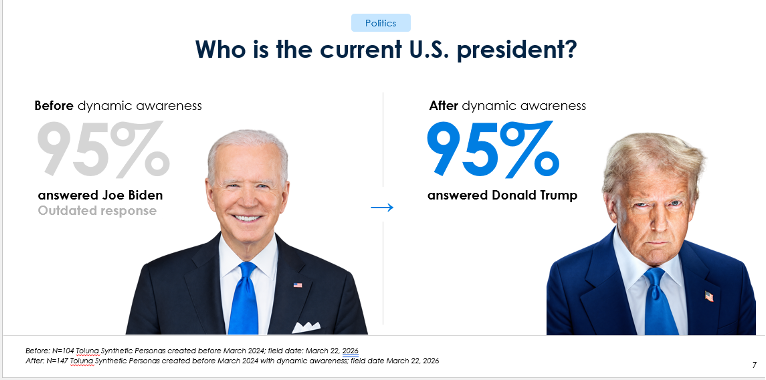
We saw similar shifts for the most recent Winter Olympics host country and Super Bowl halftime performer, where Personas without Dynamic Awareness were most likely to reference previous hosts and performers.
And while Dynamic Awareness improved awareness across all these areas, not every topic registered equally: more Personas correctly identified the current US president than the Super Bowl halftime performer, which is what we’d expect to see among humans.
But having access to current information is only part of the equation. We also want the awareness of a Toluna Synthetic Persona to reflect who they are, rather than giving everyone the same knowledge of every topic.
Universal awareness over appropriate awareness
Someone who follows football closely is more likely to be aware of what’s going on in the sport. Someone living in the state of New York will probably be more familiar with a state-level policy debate than someone living outside that state. If we are mimicking behavior realistically, then we should see these differences appear in dynamically aware Personas.
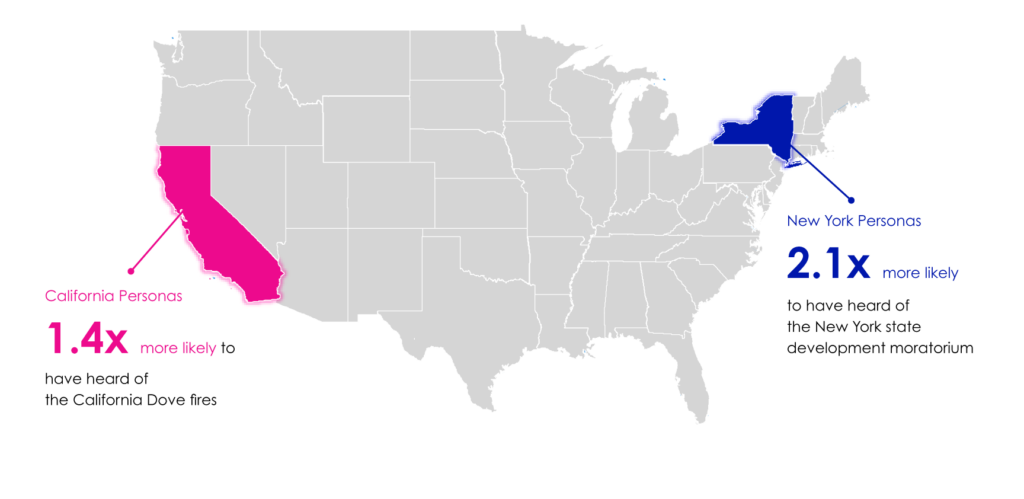
In a US study of 400 Personas, we examined recognition of recent events and factual knowledge about them, looking at differences by geography and interests. The geographic results were particularly striking:

New York Personas were 2.1 times as likely to have heard about a recent local data-center moratorium compared to Personas elsewhere in the US
California Personas were 1.4 times as likely to have heard of the Dove Fire compared to Personas in other states
That awareness of events within a specific state was more widely known among synthetic survey-takers from those states is expected, given that Dynamic Awareness is profile-driven.
We also saw profile-driven differences based on interests. In research done in July in the US, UK, France and Spain involving the World Cup, we found
Personas who said they didn’t follow the tournament were 4.8 times as likely to respond, “I don’t know” when asked to predict the winners of upcoming matches, compared with regular football followers.
Personas who said they follow major football tournaments were 2.1 times as likely to respond, “I don’t know” as regular followers.
Rather than every Persona confidently predicting a winner, their willingness to do so varied with how closely they followed the sport. That is, not only did their profiles drive awareness, but they now know when they don’t know and can say so.
Together, these findings show why Dynamic Awareness is about more than keeping Personas up to date. It’s also about allowing current information to register differently depending on who they are.
In the next article in our series, we’ll examine how dynamic awareness increases accuracy of results relative to humans.
Teaser: Across four markets, our parallel testing showed encouraging alignment in relative awareness and factual knowledge of recent events. The stories more widely recognized and understood by Humans tended to be the same ones recognized and understood by Synthetic Personas.
Dynamic Awareness doesn’t mean Humans and Personas know exactly the same things, or that up-to-date awareness by itself guarantees accurate synthetic research. But it makes Toluna Synthetic Personas more realistic and better able to mimic results from human samples in a fast-moving, ever-changing world.