






The intentional shopper: how inflation is changing the way consumers plan, prioritize, and purchase
Wave 3 of Toluna’s shopper & retail tracker reveals a consumer who remains under pressure but is becoming increasingly deliberate in response. Shoppers are protecting essential purchases, intensifying their search for value, and planning earlier for key seasonal moments. At the same time, they expect retailers to deliver convenience, availability, and value with fewer points of friction.
In case you missed the earlier findings in this series, check out wave 1 and wave 2.
Spending is rising, but consumption is not
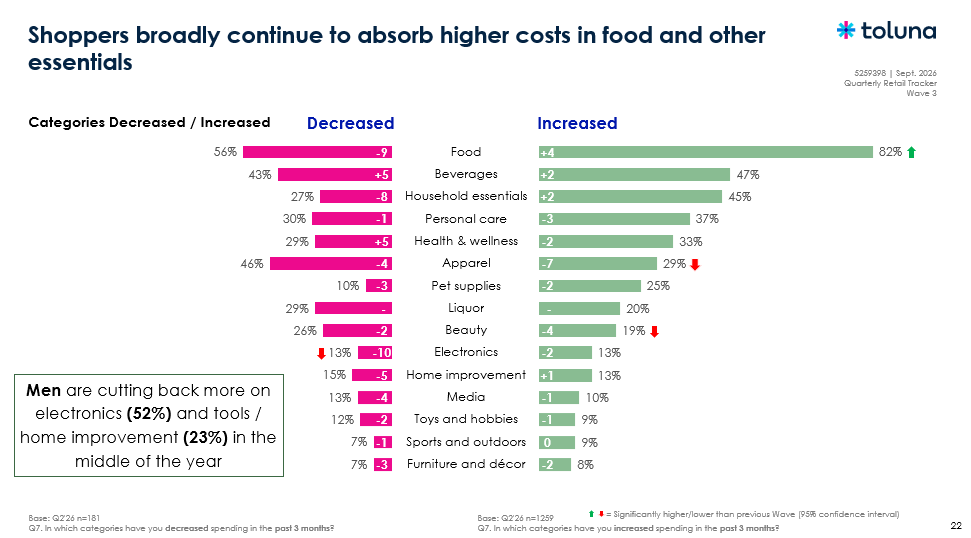
Most US shoppers tell us that their household spending has increased over the past three months. Yet the reasons behind that increase reveal a more complicated retail environment. Consumers are not necessarily filling larger baskets or purchasing more frequently. Instead, higher prices for groceries, fuel, household necessities, and other everyday expenses are requiring them to spend more simply to maintain their usual routines.
The pressure, however, is not being felt equally. Wave 3 uncovers important differences by generation, with younger shoppers reporting some of the sharpest increases in household spending. Meanwhile, women and older consumers expressed heightened concern about inflation and the cost of essentials.
Wave 3 data spotlight: Higher spending does not automatically signal stronger demand. The full report examines which consumers are feeling the greatest pressure, where their spending is changing, and what they expect over the next several months.
The consumer mood reflects these competing forces. Views of the economy remain sharply divided, although shoppers tend to express somewhat greater confidence in their personal financial outlook than in the economy overall.
For brands and retailers, understanding the difference between rising expenditure and true category growth will be critical heading into the final months of the year.
Essentials remain the center of gravity
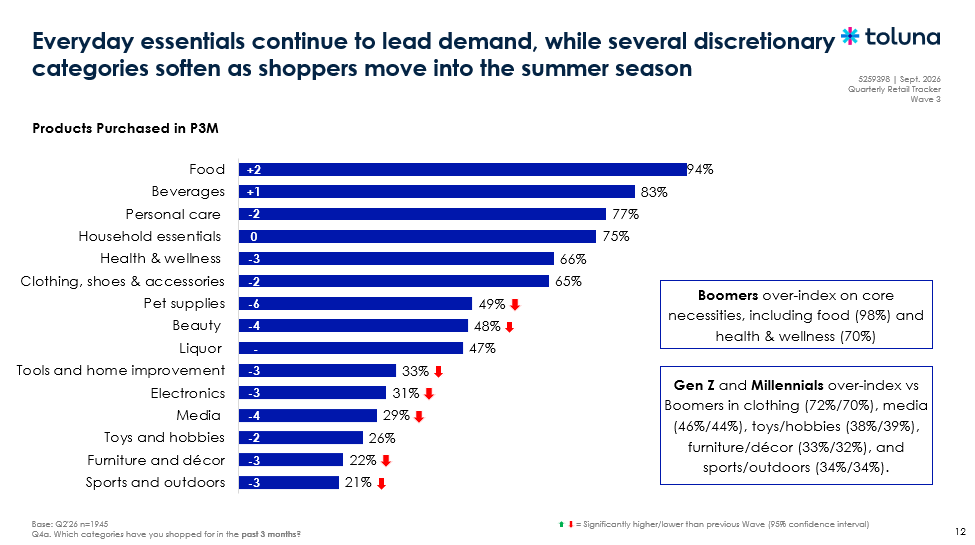
Everyday necessities continue to anchor demand, with food, beverages, personal care, and household essentials leading recent purchasing. Grocery and mass retailers capture the greatest share of household spending, while club and online channels form an important secondary tier.
Discretionary categories tell a different story. As shoppers contend with higher essential costs, many are applying greater scrutiny to purchases that can be postponed, reduced, or avoided altogether.
Those decisions also vary considerably across generations. Older shoppers remain especially focused on core necessities, while younger consumers continue to participate more actively in several lifestyle and discretionary categories.
What the full report reveals: Which categories are holding up, which are softening, and where generational differences may create overlooked growth opportunities.
How consumers access those categories is also evolving. Hybrid shopping remains the dominant behavior, with shoppers comfortably moving between in-person and online channels. This blended journey is especially prevalent among younger generations, making channel integration an expectation rather than a differentiator.
Value-seeking has become an embedded discipline
The value mindset identified in waves 1 and 2 is not fading. It is becoming more intentional and more deeply embedded in everyday shopping routines. Consumers are increasingly comparing prices, searching for sales, delaying non-essential purchases, switching brands, and buying more store-brand products. Reduced shopping frequency is also becoming part of the value toolkit, suggesting that some shoppers are managing costs by limiting opportunities to spend altogether.
Yet value does not mean the same thing to every consumer.
The full wave 3 findings reveal clear differences across generations and retail formats. Older shoppers are more likely to rely on private labels, sales, and purchase delays. Younger shoppers use a different mix of strategies, including bulk buying, smaller pack sizes, subscription reductions, and selective trading up.
This makes a single value proposition increasingly difficult to sustain. Retailers and brands need to understand not only whether shoppers are seeking value, but how each audience defines and evaluates it.
The strategic question: Is your value proposition built around the behaviors shoppers are using today, or around assumptions from a less constrained retail environment?
Retail choice remains pragmatic, but expectations are rising
Price and convenience continue to lead retailer choice. Assortment, promotions, and the ability to meet multiple needs in one trip also play significant roles.
However, the reasons a shopper chooses a retailer do not always mirror the reasons they reject one. Proximity and budget fit are powerful barriers, but shoppers also point to gaps in assortment, product availability, quality, service, and checkout efficiency.
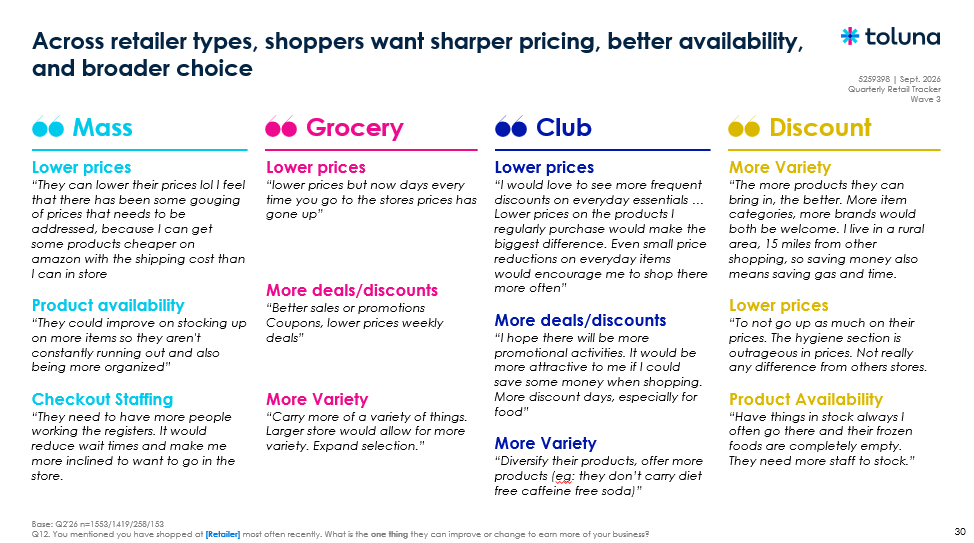
When asked what retailers could do to earn more of their business, consumers consistently returned to several retail fundamentals:
- Sharper and more transparent pricing
- Better product availability
- More compelling promotions
- Broader and more relevant assortment
- Faster, easier shopping experiences
The priorities shift by channel. Discount shoppers, grocery shoppers, club shoppers, and mass retail shoppers do not evaluate value or convenience in the same way.
Generational expectations also add another layer. Younger shoppers are more likely to consider digital usability, specialized health and dietary products, store values, and sustainability alongside more traditional retail factors.
Exclusive wave 3 analysis: The full presentation maps the drivers and barriers of retailer choice across generations and key retail formats, identifying where expectations converge and where strategies need to diverge.
Getting the fundamentals right remains essential. But for retailers competing for younger shoppers, fundamentals alone may not be enough.
Seasonal shoppers are planning earlier and more carefully
Wave 3 offers a timely look at how financial pressure has shaped back-to-school and is shaping early holiday planning.
Back-to-school participation was selective, and active shoppers were motivated to start earlier. Sales and lower prices are part of the equation, but availability also matters. For some consumers, shopping early is a practical safeguard against paying more or missing the products they need.
Holiday expectations reveal a similar mindset. Most shoppers anticipate keeping their budgets steady or increasing them modestly, but many are already planning strategies to maintain control. These include starting earlier, setting stricter budgets, shopping promotions, trading down, and buying fewer gifts.
This creates an important tension for retailers: shoppers may spend as much as or more than last year, but they will be working harder to maximize what that budget delivers.
Holiday planning preview: The full wave 3 report identifies the offers, services, and incentives most likely to influence retailer choice during the 2026 holiday season, including where priorities differ across shopper groups.
The strongest holiday propositions will deliver value without adding complexity. Shipping, discounts, rewards, returns, price protection, delivery reliability, and product availability all have a role to play, but they do not carry equal weight.
Retailers preparing for the holiday season need to know which levers are most likely to change behavior before promotional calendars and activation plans are finalized.
The intentional shopper raises the stakes for retailers
Wave 3 shows a shopper who is adapting rather than retreating.
Consumers continue to absorb higher costs, but they are doing so with greater planning, comparison, and discipline. They are narrowing discretionary decisions, formalizing value-seeking behaviors, shopping across channels, and preparing earlier for seasonal spending.
This creates both risk and opportunity.
Retailers that interpret higher spending as increased consumer confidence may miss what is happening beneath the topline. Brands that rely on broad promotions without understanding how value differs by generation may sacrifice margin without changing behavior. Social campaigns that prioritize reach over relevance may add to shopper fatigue rather than build consideration.
This post highlights only part of wave 3 of Toluna’s quarterly retail tracker. Request a presentation of the full wave 3 report to explore the findings, understand the differences across audiences and retail formats, and discuss what they could mean for your business.
Contact us to schedule a personalized presentation and discussion: Christine Ciullo christine.ciullo@toluna.com
Wave 3 of Toluna’s Shopper & Retail Tracker was conducted via Toluna Start and fielded between June 29 and July 9, 2026, among 2,000 US primary household shoppers aged 18 and older.
The full wave 3 presentation is designed to help retailers and brands move from broad trends to actionable decisions, including: